
Is Backing Into a Parking Space Safer?
The safest way to park may surprise you.


When you’re in a parking lot or garage where the parking spaces are perpendicular to the flow of traffic, how do you enter your chosen spot: Drive straight in, nose first? Or do you reverse park, backing in?
For many drivers, it’s a question of circumstances and personal preference. The decision may depend on traffic conditions, how crowded the parking area is, and how comfortable they feel backing up. But it’s also a question of safety.
Parking can be risky.
There are more than 50,000 parking lot crashes every year, resulting in 500 deaths and 60,000 injuries, according to the National Safety Council (NSC), which advocates for reducing risk in workplaces and on roadways. Just walking through a parking area can be dangerous: In 2021 (the most recent year for which the National Highway Traffic Safety Administration has numbers), 234 pedestrians were killed and 11,000 injured by vehicles in parking lots and driveways.
Part of the problem is a lack of clear guidance as to who should yield to whom in a parking lot. The way parking lots and garages are designed, “it’s sort of like having 100 different intersections all smooshed [together], with fewer traffic controls,” says William Van Tassel, manager of driver training programs for AAA. “People are on their own to figure it out.”
Many people also seem to view driving in a parking lot differently from doing so on the street. For example, according to an NSC poll, two thirds of drivers admitted that they talk on the phone while navigating parking lots; less than half say they do so on highways and surface streets. The numbers are similarly skewed for doing things like taking photos or watching videos.
In this frequently chaotic environment, backing out of a parking space can be extra risky. For one thing, backing up in general is dicey. Drivers spend less than 1% of their time in reverse, according to the NSC, but that’s when 25% of collisions occur. Vehicles handle differently in reverse: Steering can be 10 times more responsive, says Van Tassel. “The slightest turn of the wheel can give you a far bigger response than you want.”
Even with backup cameras, it can be difficult to be fully aware of what’s going on around you when you’re in reverse. “Your visibility is really limited,” says Julia Kite-Laidlaw, senior program manager of Road to Zero at the NSC, “and pedestrians might enter blind zones unexpectedly.”
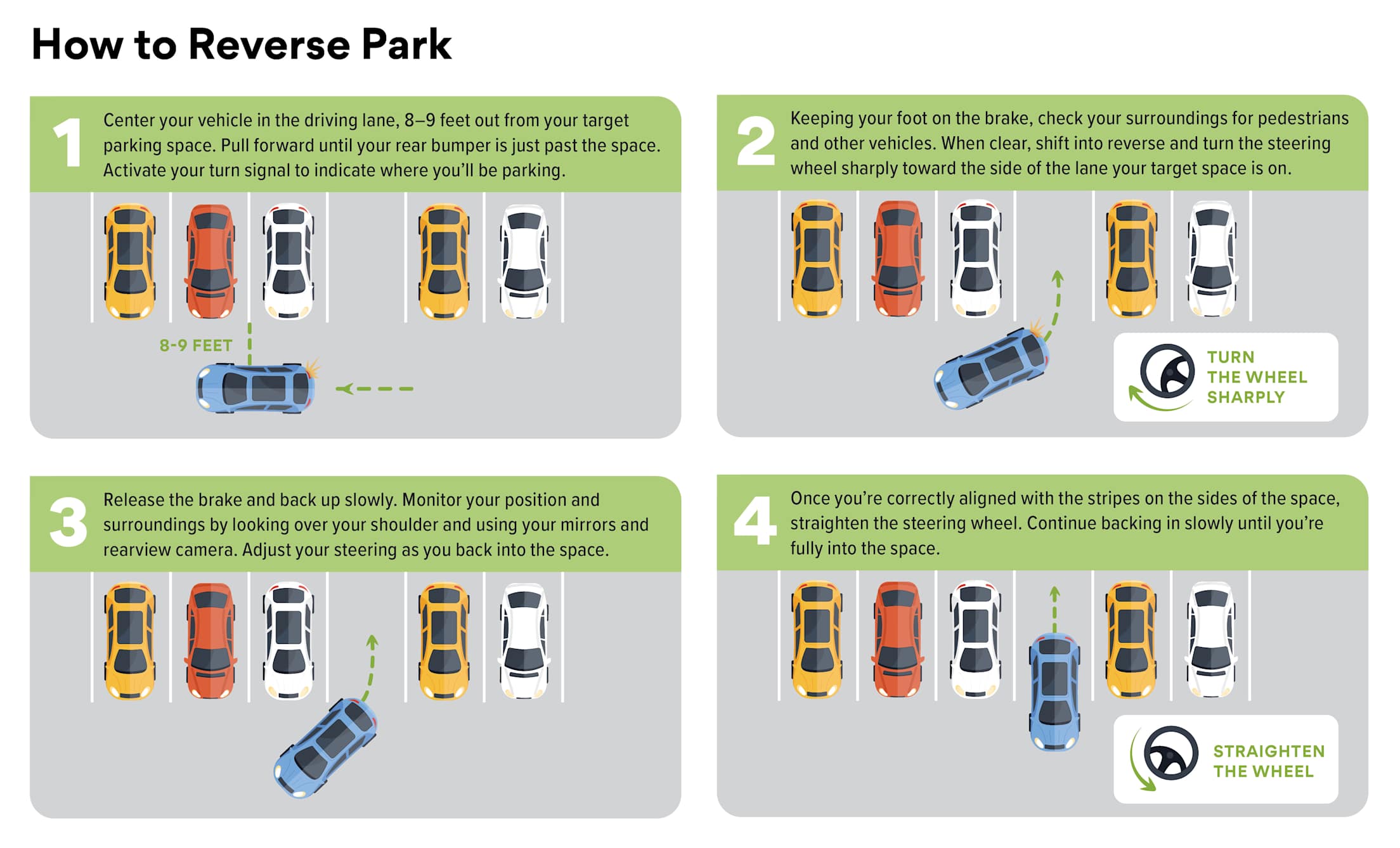
Reverse parking makes sense.
For all those reasons, many safety organizations and driving instructors say it’s safer to back into a parking space—so you’re driving forward when you leave—than it is to enter the parking space nose-first.
For example, a study at North Carolina State University’s Institute for Transportation Research and Education found that the 74% of drivers who parked front first and backed out of their spaces were involved in 91% of crashes.
Nose-out parking can also save drivers money in the form of lower insurance premiums and fewer repairs. “At least 30% of our jobs are parking lot accidents,” says Monica Morabito, general manager of Kaizen Collision Center in Camp Verde, Arizona. “It’s usually two people backing up at the same time or someone zipping through the aisles.”
Other Ways to Make Parking Safer
While reverse parking is the safer alternative, it’s not the only way to reduce the chance of a parking lot accident.
- Keep your distance. If you can, park away from other cars, to minimize the chance of a collision or being hit while you’re walking.
- Take your time. Drive slowly in parking lots—no more than 5 to 7 mph, says Kite-Laidlaw. Low speed gives you more time to react and lessens the impact of a collision.
- Pull through when possible. If you’re in a parking lot that doesn’t have concrete parking curbs at the top of every space, Van Tassel recommends looking for two empty parking spaces lined up nose to nose. Drive straight into the first space, then keep driving into the second, so your car’s front is facing the aisle. You get all the advantages of reverse parking without having to back up.
- Buy the right car. Rearview cameras and sensors that warn you when you’re about to hit an obstacle make backing into parking spaces way easier, and they are now found in almost all new and many used cars. Rearview cameras alone can slash back-up crashes by 17%, according to the Insurance Institute on Highway Safety (IIHS), the insurer-funded nonprofit research organization; for drivers older than 70, cameras can cut crashes by 36%.
Even better, automatic rear braking, combined with rearview cameras and sensors, can reduce those back-up crashes by 78%, according to the IIHS. While automatic rear braking isn’t yet a common feature, it is an option on some 2026 models from Subaru, Honda, Nissan, Mazda, and others.
From teen programs to courses for mature drivers, AAA has driver education resources for every life stage.