
Buying a Car in 2026? Here’s What You Need to Know
Consider tariffs, tax credits and deductions, and interest rates in your calculations.


If you’re in the market for a new car in 2026, the good news is that the supply-chain disruptions that choked inventories and sent prices through the roof during the pandemic have mostly dissipated. This year, you should now have more cars to choose from and more time to decide on your purchase.
At the same time, several new factors could complicate that decision: Expanded tariffs on imported cars and components; the loss of federal EV tax credits; a new federal tax deduction on auto-loan interest; and (potentially) lower interest rates.
Here’s how those changes could impact buyers this year and what experts advise for navigating the new landscape.
Will tariffs raise prices?
In March 2025, President Trump announced a new 25% tariff on imported cars and light trucks and some imported auto parts. At that time, about half of all vehicles sold in the United States—and almost 60% of parts used in vehicles assembled in the United States—were imported, according to EY.
Since then, the Trump administration has cut special deals with some countries, so right now those tariffs are literally all over the map. Stephanie Brinley, associate director of research and analysis with S&P Global Mobility, calls the current tariff structure “insanely complex but relatively stable.”
So far, automakers have mostly been absorbing the costs of those tariffs themselves, without passing them along to consumers. “It may be that automakers have realized that the car buying public is fed up with how expensive cars have gotten,” says Joseph Yoon, consumer insights analyst at Edmunds. (According to Edmunds, the average transaction price of a new vehicle in November was just under $50,000, not including rebates and incentives.)
“It’s tough trying to predict how much longer the automakers can continue eating the costs of the tariffs,” Yoon says. “We feel they can’t do it forever.” Several companies have already announced potential tariff-related price increases.
Car companies “are telling us privately that prices will float up,” says Sean Tucker, managing editor of Kelley Blue Book. Brinley also expects a price increase, but does not expect that tariffs will appear as separate line items. “It will be managed carefully,” she says.
Automakers generally wait until a new model year comes out to raise prices. They can then say they’ve updated a trim level or added a new standard feature to justify a higher price. At that point, they could add in some tariff costs.
Buyers should “scrutinize every make and model,” says Mike Quincy of Consumer Reports. Some manufacturers will pass their increased costs to consumers, others won’t.
And buyers shouldn’t feel pressured to buy before tariffs are passed on. “Generally, automakers spend more on incentives as the model year ages,” says Tyson Jominy, senior vice president of OEM customer success at JD Power. He expects incentives to go up as inventories continue to rise. While Jominy expects prices to rise about 1.5% in 2026, “this is still well below the historical mean of 2.2% for 2010–2019.”
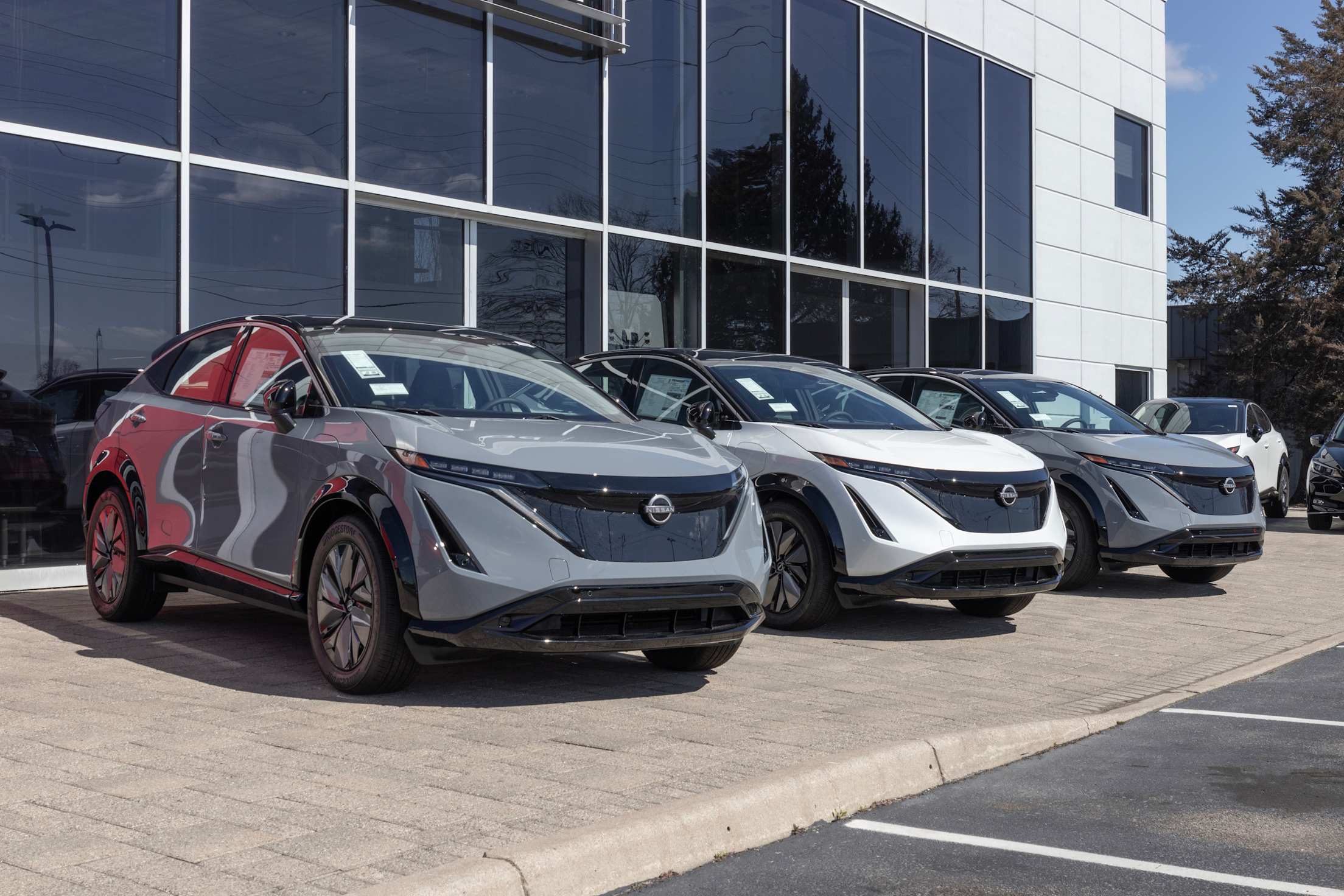
EVs Without Tax Credits
In the big tax bill passed in July, Congress killed the federal clean-vehicle credit for new and used EVs and plug-in hybrids sold or leased after Sept. 30, 2025—seven years ahead of schedule. That led to a frenzy of EV purchasing and leasing activity before the deadline. Afterward, as demand cooled, some automakers offered discounts to clear out inventory, especially for 2025 models.
Those discounts probably won’t last long, as inventories shrink and EV production slows in response to the expired credits as well as the proposed relaxation of government fuel-economy standards.
Without the credit, EVs cost considerably more than hybrids or gas-powered cars. In October, average prices (before most incentives) for new cars were $70,247 for a plug-in hybrid electric (PHEV), $64,146 for a pure EV, $48,972 for a gasoline-powered car, and $43,519 for a standard hybrid, according to Edmunds.
“If you want an EV, there are plenty available,” Kelley Blue Book’s Tucker says. But he also says, “I don’t see how manufacturers can cut the price of a new EV, because their profit margins on EVs are slim or none.”
Some states and electric utilities are still offering incentives for EVs and home chargers. If you live in a designated low-income or nonurban census tract, you can still get a federal tax credit if you install home charging equipment before July 1, 2026. The Alternative Fuel Vehicle Refueling Property Credit is worth 30% of the cost, including installation, or $1,000, whichever is lower.
Another option is leasing, which makes more sense for an EV than a gasoline-powered car because EV technology changes so rapidly and EVs depreciate faster. Your monthly payments will be lower with a lease than a purchase, although you’ll own nothing when the lease is up.
Buyers can also consider used EVs. Leasing of EVs exploded before the tax credit expired because it was much easier to get the benefit of the credit on a lease than a purchase. As a result, “we will have about a million EVs coming off lease annually through 2028,” Jominy says.
The best deals this year will be used EVs coming off 2021 and 2022 leases, Yoon says. Although used models may have less range than newer ones, “the depreciation was so big they are hitting the market at really great prices,” especially compared to their original stickers. Yoon advises buyers to stick with certified pre-owned EVs coming off branded-dealer lots.
If you want a fuel-efficient vehicle that’s cheaper and more reliable than an EV, Quincy recommends looking at regular (not plug-in) hybrids. Hybrids are slightly more expensive up front, but could help save drivers money because of their gas-saving benefits. They’re also more reliable: Consumer Reports found that hybrids have 15% fewer problems than gas-only cars.
On an apples-to-apples basis, a hybrid will cost more than a comparable gas-powered vehicle, but it usually takes only two to three years to recoup the cost in fuel savings, Jominy says. Because hybrids are “hugely popular right now,” Yoon says, you shouldn’t expect any major discounts.

Interest Rates and Financing
President Trump is pressuring the Federal Reserve to cut interest rates aggressively. More Fed rate cuts could ease financing for some buyers, but there’s no guarantee auto rates will fall at the same pace.
Since September 2024, the Fed has cut its short-term federal funds rate by a total of 1.75 percentage points. In that same period, the average new-car loan rate has fallen by only 0.4 percentage point, from 7.1% to 6.7%, according to Edmunds data. During the first two years of the pandemic, that average auto-loan rate was at or below 4.5%. Auto loans, which now average 70 months or nearly six years, respond not only to short-term but also to long-term rates, which also haven’t dropped nearly as much as the Fed funds rate.
All that said, what you pay for an auto loan depends on more than just the Fed.
“Even with the Administration pressuring the Fed to cut rates as soon as possible, it doesn’t make much difference when the price of vehicles is so high,” Yoon says. “Because people can’t afford the monthly payments, they are taking out longer and longer loans, seven and eight years. Even if the interest rate gets lower, when you take out a longer-than-average loan, the bank assigns you a higher rate.”
What you can control is your loan size and term, down payment, and credit score. In Q3 2025, auto-loan rates ranged from 4.9% for borrowers with the highest credit scores to 15.9% for those with the lowest, according to Experian. So rather than waiting for the Fed, the best way to get a lower rate on a car loan is to improve your credit score or take out a shorter-term loan.
Auto-Loan Interest Deduction
The big tax bill in July also created a new federal deduction for auto loan interest—but there are lots of strings. To qualify, you must purchase a new (not used) vehicle weighing 14,000 pounds or less for personal use. You can deduct up to $10,000 in interest on a standard loan (not a lease), but only for tax years 2025 through 2028 on loans originated after Dec. 31, 2024.
The biggest gotcha: The vehicle must have had its final assembly in the United States. That disqualifies more than 40% of new cars. You can see where a specific car was assembled on the car’s window sticker or the government’s online VIN decoder. Alternatively, you can check the VIN number yourself: If it begins with 1, 4, 5, 7F–7Z, or 70, that indicates it was assembled in the United States.
You can claim the credit whether you take the standard or itemized deductions. But it starts phasing down if your income exceeds $100,000 (single) or $200,000 (married) and is gone at incomes $50,000 above those thresholds. Unlike a tax credit, which reduces your taxes dollar for dollar, a deduction reduces your income before taxes are calculated. So the benefit is less and depends on your marginal tax rate.
Also remember that most auto loans are amortizing, which means your monthly payment will be applied more to interest than principal in the early years; that ratio reverses as time goes on. To calculate your potential savings each year, first estimate your annual interest using an amortizing loan calculator like this one at Calculator.net. Then multiply the interest portion of your annual car payment by your marginal tax rate (expressed as a percentage).
Suppose you take out a $40,000 car loan at 8% for six years in 2026. You’ll pay about $3,000 in interest the first year. If you’re in the 22% federal tax bracket, you’ll save about $660 in taxes ($3,000 x 0.22). In years two and three, you’ll save about $560 and $455, respectively—about $1,700 total. The higher your tax rate, and the bigger your loan, the larger the deduction. After 2028, you’ll get no deduction.
“Deducting interest while filing taxes doesn't tangibly help customers when they're looking at monthly payments at the dealership—especially since it's unlikely that you're going to get an interest amortization schedule while negotiating terms,” says Yoon. “With all that put together, it's a very difficult task to see how much you'd be eligible to claim on tax returns.”
When it was first announced, Jominy saw some automakers advertise the deduction. But “I haven’t seen anyone mention it in a while—it’s proving to be too much of a headache.”
“Whatever you do,” Jominy says, “Do not get your tax advice from a car dealer. Listen to your tax professional.”
AAA Members save on new cars and find great deals on pre-owned vehicles with TrueCar.