
Road-trip Through Nevada’s High Desert
Between Reno and Las Vegas, Highway 95 unfolds into a gallery of ghost towns, desert art, haunted hotels, and star-crowded skies.


In between the glittering lights of Reno and Las Vegas, the landscape sparkles with its own unique beauty. A sea of sagebrush reaches toward low-slung peaks and striated plateaus, spiky Joshua trees twist beneath an endless blue sky, and mustangs run wild. Nevada’s high desert may seem unforgiving at first, but its arid climate has helped protect the remains of numerous mining towns as well as some surprising outdoor art. As spring begins to brighten the Great Basin, take a gamble on this route and discover all the prizes it holds.
Reno to Fallon
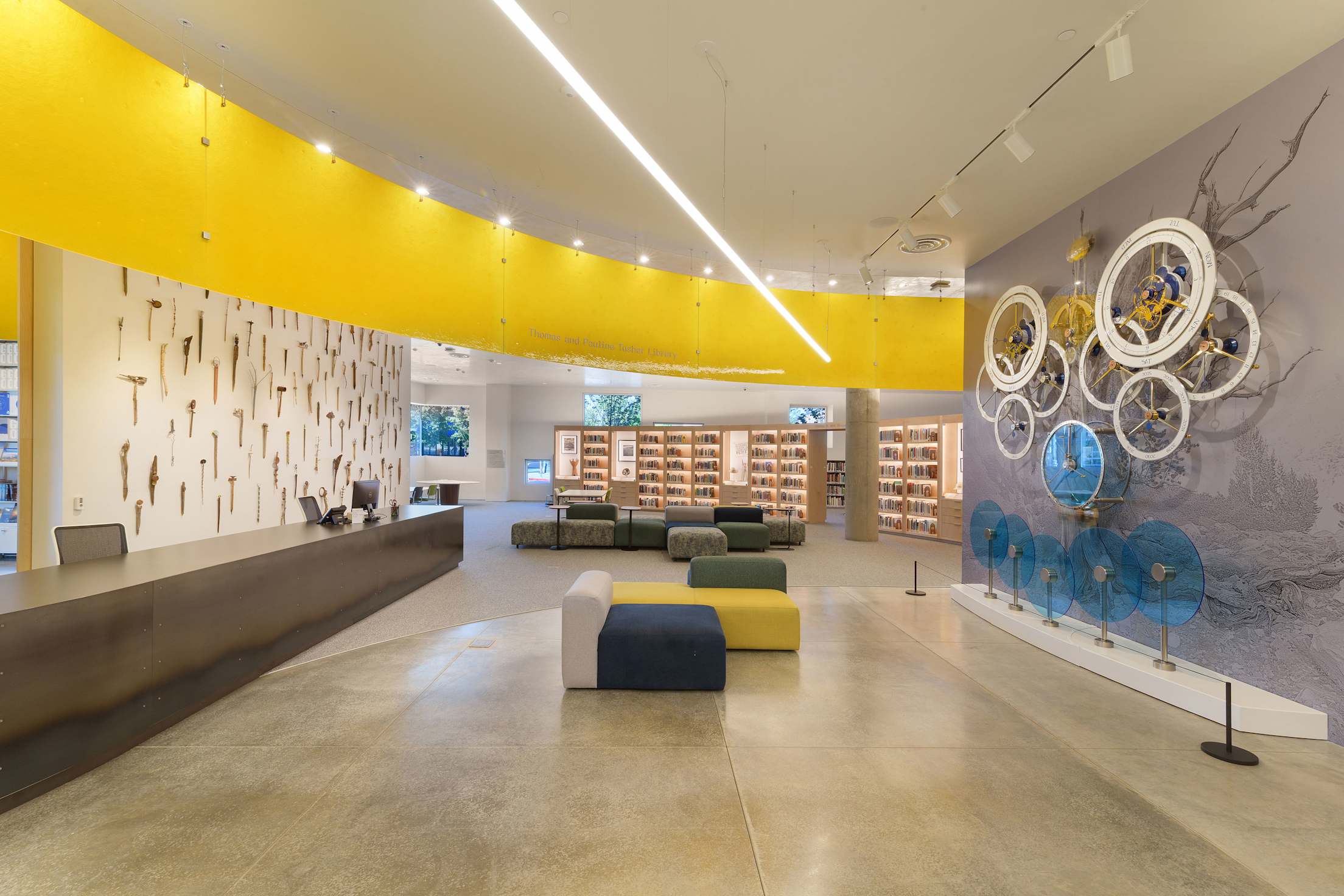
At the Nevada Museum of Art in Reno, engage with exhibits that explore our relationship to the natural world. Stroll through the rooftop garden blooming with crimson-red firecracker beardtongue, purple-pink devil’s claw, and other plants used in traditional Native American basket weaving. Ponder the vast scope of time in front of Centuries of the Bristlecone, a dual-pendulum clock that contrasts our brief, harried lives against the slow growth of the Great Basin bristlecone pine, one of the oldest living organisms on Earth. Or pull open a drawer at the research library to skim “A Practical Guide to the Desert,” a flier by Burning Man festival organizers. (One noteworthy observation: “All objects—human beings, cars … drastically diminish in the scale of the desert.”)
An hour east, in the agricultural hub of Fallon, a neon cowboy ropes travelers into an unexpected art oasis. Housed in a former brick school building, Oats Park Art Center’s three classrooms-turned-galleries defy expectations for a town of around 9,600 residents. The center’s collection of regional art includes a 10-foot wide reinterpretation of Leonardo da Vinci’s The Last Supper as courtly face cards at a craps table; the state seal of Nevada ominously cut into a trefoil radiation symbol; and Crank, six interconnected bass drums that beat to the rhythm of people moving around the room-sized sculpture. (Galleries open Wednesday, 9 a.m.–1 p.m., and Friday, 10 a.m.–5 p.m.)
Fallon to Tonopah
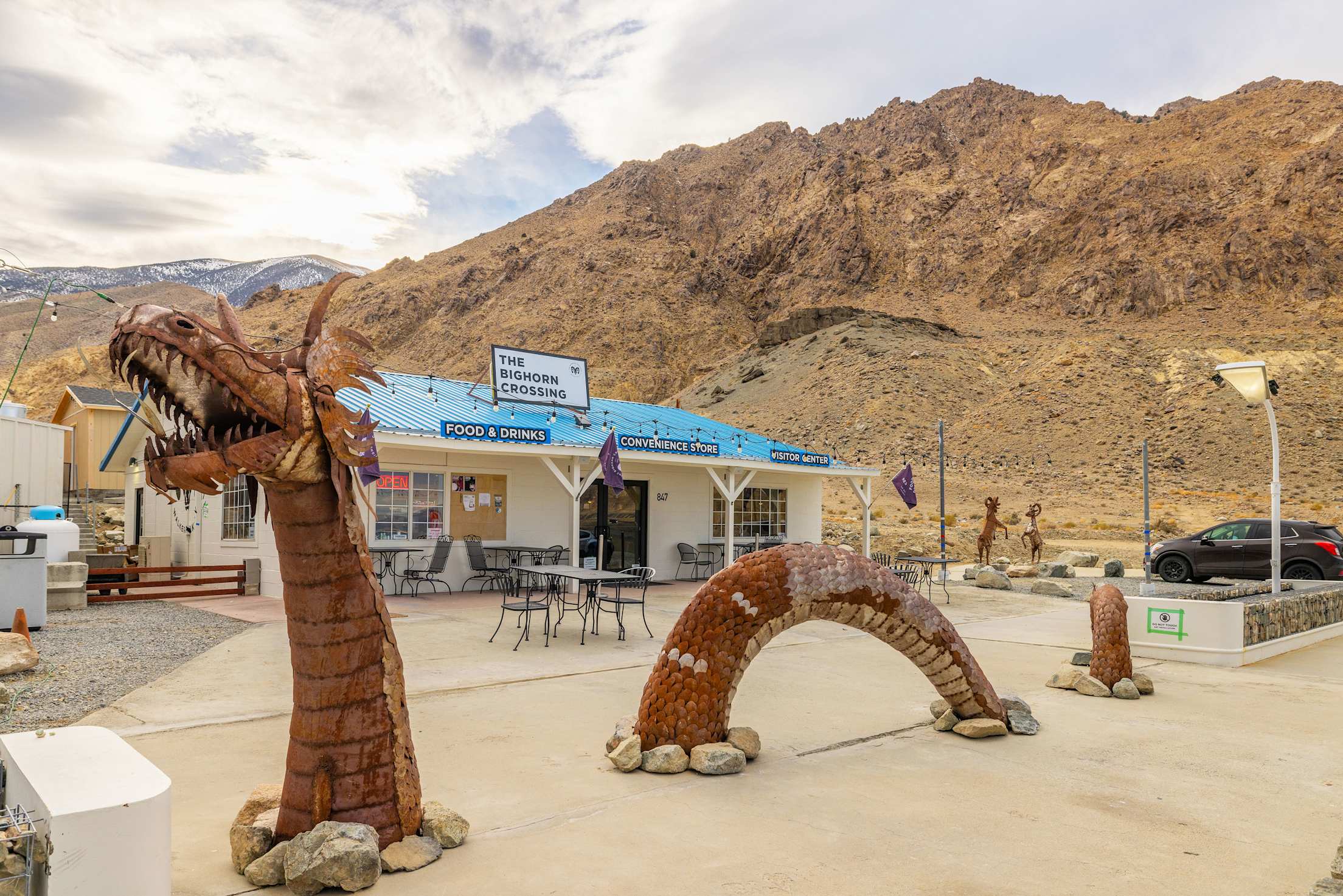
Head south out of town on Highway 95. As you continue alongside the craggy peaks of the Wassuk Range, shimmering Walker Lake emerges from the gravel and rocks on your left. Pull over for lunch at The Bighorn Crossing (desert bighorn sheep pass through the restaurant’s parking lot almost daily) for an expansive view of the lake’s silver surface. Along with succulent Korean barbecue pork tacos, grass-fed beef burgers with kimchi aioli, and fries cooked in beef tallow, co-owner and Mineral County commissioner, Tony Ruse, serves up the latest news on the local effort to restore the lake to the fishing and birding destination it was when he was a kid, before upstream irrigation diversions depleted water levels.
About two hours southeast, dig into history with a touch of horror in Tonopah, a former silver-mining outpost. At the town’s historic mining park, you can tour a tunnel, stare down an illuminated 600-foot shaft, and gaze into a cave-in that swallowed the first assay office. But to get a sense of the characters who lived (and died) during the boomtown days, read the epitaphs in the Old Tonopah Cemetery, where more than 300 residents were buried from 1901 to 1911. Among the many miners who were killed by runaway ore cars, dynamite, and shaft fires, you’ll also find a high-society con artist, a sheriff shot outside a brothel, and a charismatic saloon owner who supposedly still plays pranks at the Tonopah Liquor Company.
At the Clown Motel next door, you could try to sleep in a room while clown paintings smile down at you, or just pop in to witness the motel’s kitschy-creepy collection of over 6,500 red-nosed figurines, life-size clown mannequins, and ghoulish Pennywise portraits. (Fair warning: The current owners have tipped the scales toward scary.)
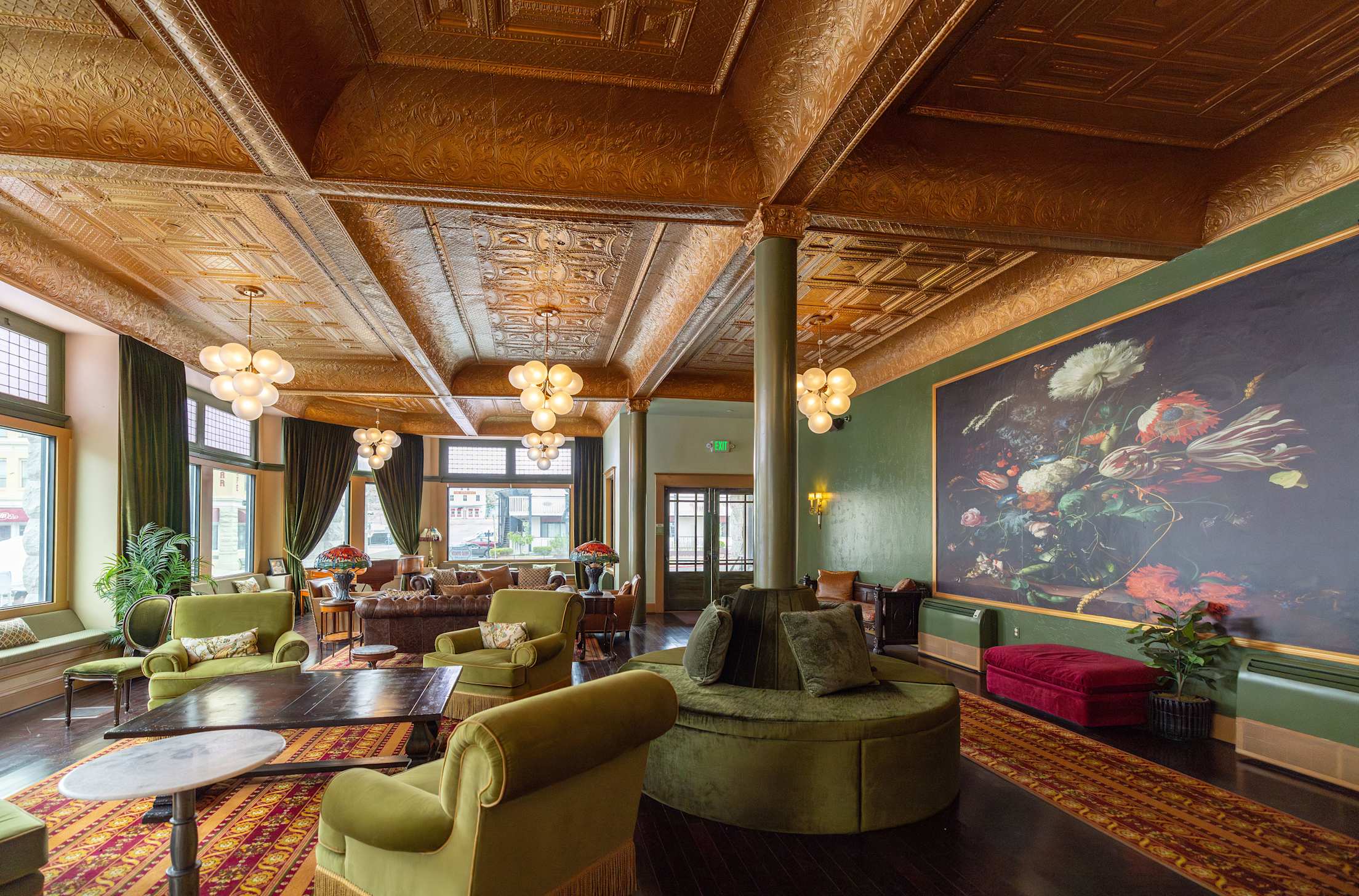
Further down Main Street, rest in turn-of-the-century luxury at the Mizpah Hotel or the Belvada Hotel across the street. Both hotel lobbies feature tufted velvet couches and stained-glass lampshades, while the rooms continue the gilded vibes with scarlet velvet drapes and decorative metal headboards. For your best chance for a spirited sleepover, book the Mizpah’s Lady in Red Suite, where a legendary hotel resident once plied her trade. Supposedly, the suite’s friendly phantom occasionally tucks pearls under guests’ pillows.
One big benefit of staying in a remote small town? Bright nighttime skies. Before bed, have a seat at one of the concrete benches at the Clair Blackburn Memorial Stargazing Park and stare up at a sky crowded with twinkling constellations, nearby planets, and the cloudy spill of the Milky Way. From May through September, join local astronomers for a stargazing party and peer through the provided telescopes and binoculars.
Tonopah to Beatty
The next morning, stop by Gemfield and wander across a vast, shimmering array of chalcedony in every color of the sunset—from carnelian to lavender. Fill your pockets with shards to polish later or peruse jewelry showcasing the banded stone at the Rusty Cove Boutique and Enigmata Esoterica in Goldfield, just four miles away.
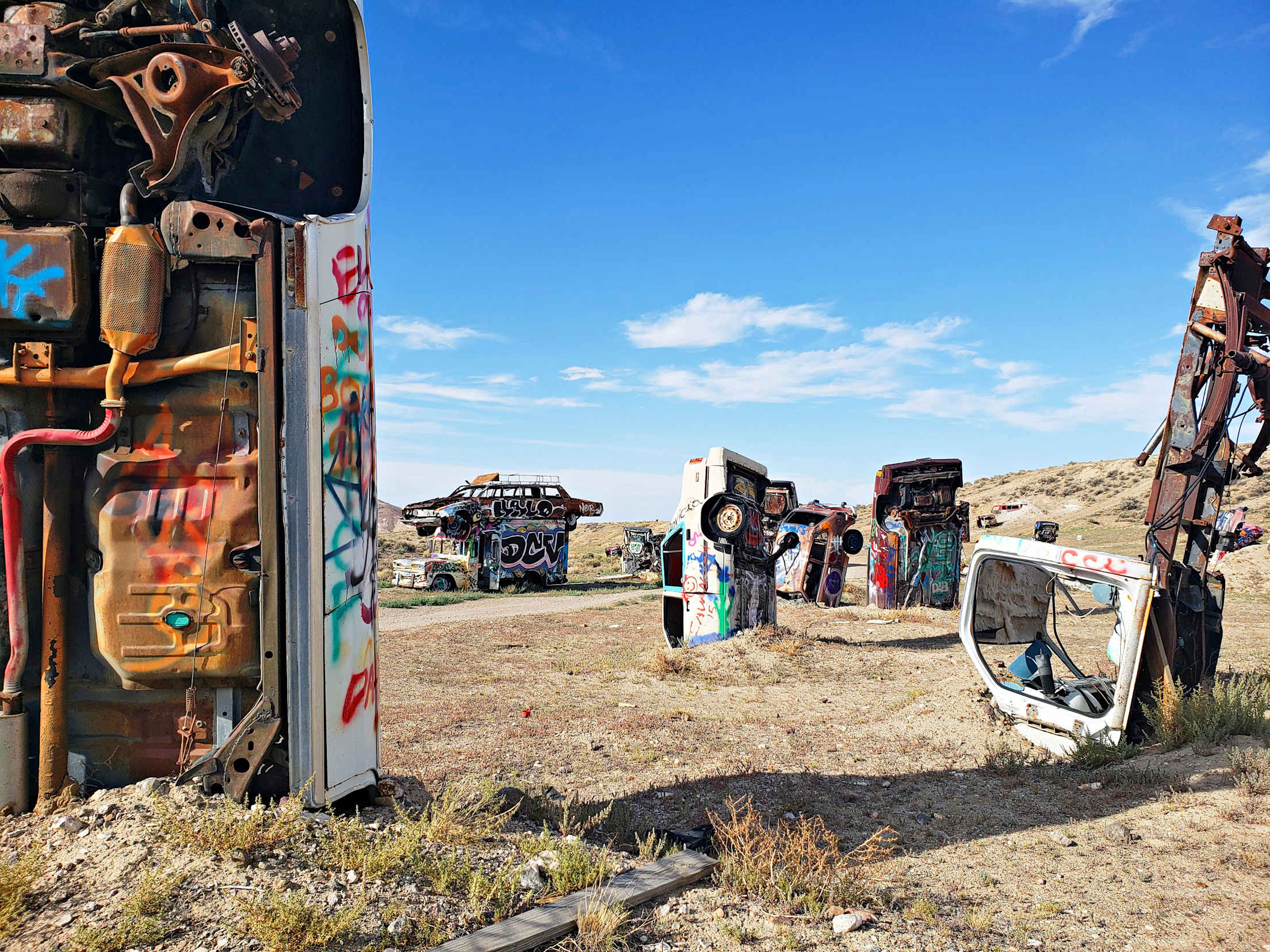
The once-bustling gold-mining town of Goldfield is now an eccentric mix of creative artists and crumbling buildings. Gingerly pose next to rusting Ford Model Ts and ogle a small fleet of sun-bleached art cars. Rockette Bob, an early Burning Man gearhead, covered every inch of his creations with detritus—weathered Lego mosaics, poker-chip scales, and garden-hose fringe. One car is topped with a boat, another with a VW bug frame. Then, check out the International Car Forest of the Last Church, where dozens of artfully graffitied cars and buses appear to have nose-dived into the earth.
Near Beatty, a gateway town to Death Valley National Park, make a short detour on Highway 374. Here, in the shadow of yet another hillside ghost town, rise the enigmatic and whimsical sculptures of the Goldwell Open Air Museum. Tromp across the dusty terrain to see the museum’s most famous piece, a plaster reimagining of The Last Supper as 13 spectral shrouds. Built in 1984, the tableau was intended to stay for two years but has survived for more than 40. Other works include a towering nude woman shaped out of Lego-like cinderblocks and a 26-foot-tall steel silhouette of Frank “Shorty” Harris (the 5-foot-4-inch prospector whose strikes sparked multiple boomtowns) with a penguin.
One sculpture encouragingly spells out the phrase “Keep Going.” Take heed and meander over to the remains of Rhyolite, which went from boom to bust in less than 15 years. A relatively sturdy train station stands watch next to long-gone tracks, and the skeletal ruins of a bank sits open to the elements. Be sure to peek into the remarkably well-preserved Tom Kelly Bottle House, made mostly out of some 50,000 unwashed beer bottles and adobe in 1906. (Wood and water were scarce, but thanks to the town’s 50-plus saloons, discarded beer bottles were abundant.) See if you can spot the “Rhyolite mummies,” the white carcasses of crickets interred in one of the glass tombs.
Beatty to Las Vegas
Return to Highway 95, and go back even further in time at Ice Age Fossils State Park, just 20 miles north of the Las Vegas Strip. Paleontologists have unearthed thousands of fossils here, evidence of an era when dire wolves, American lions, and camelops (ancient camels) roamed a lush, green marshland. Around 12,000 years ago, humans joined the valley’s remaining megafauna and began to leave their mark.
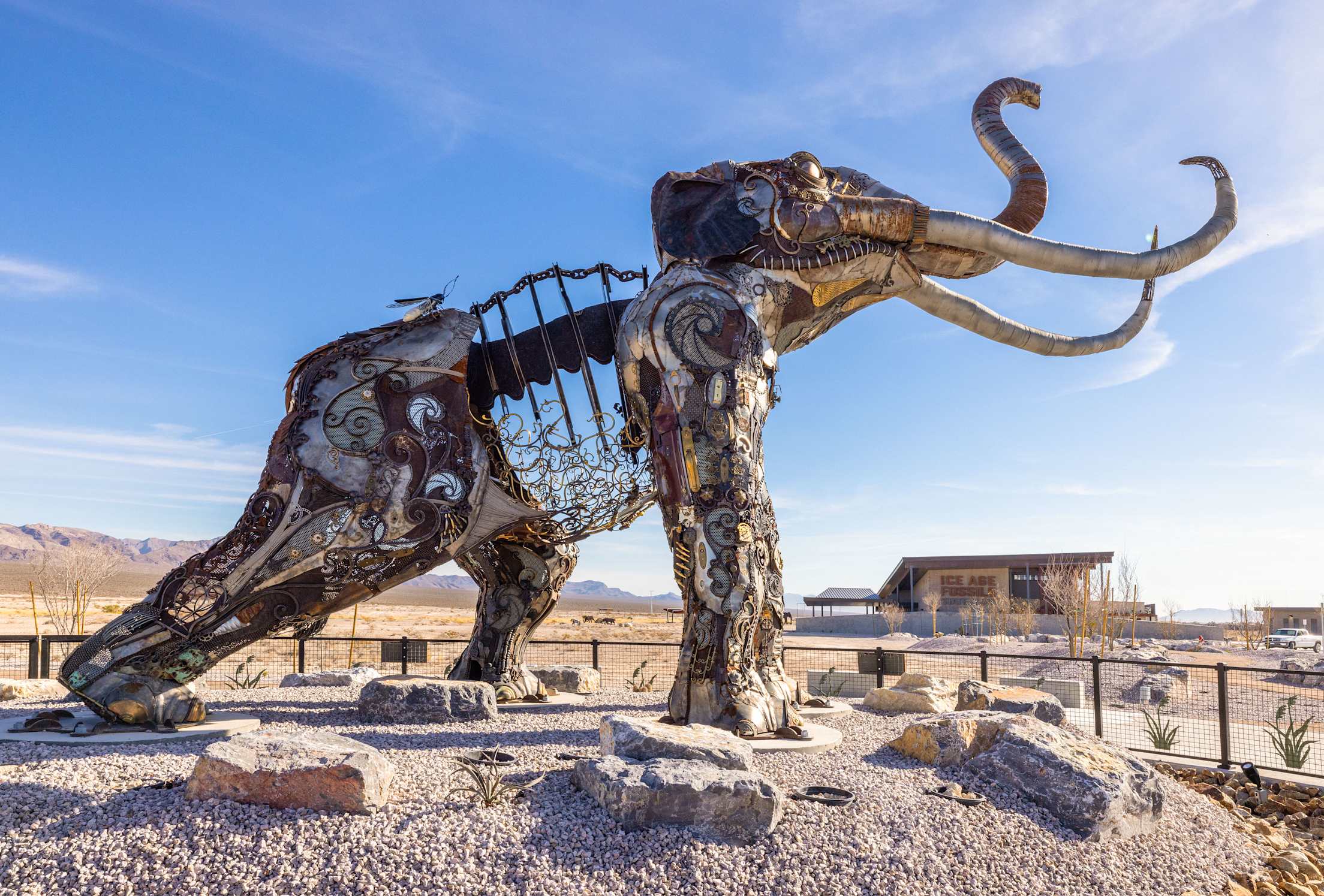
At the park’s entrance, the life-sized Monumental Mammoth welcomes visitors—and reminds them of our recent outsized impact: Bullet casings, bicycle chains, and bed frames collected from the adjacent Tule Springs Fossil Beds National Monument (a former dumping ground) all contribute to the intricate patterns and Fibonacci spirals on the beast’s metal skin.
While walking the park’s three gentle trails, stay alert for things poking out of the ground: In 2024, a park visitor spotted a partial Columbian mammoth tooth. It’s just another example of the unexpected treasures to be found along this offbeat route of natural and human-made wonders.